Quick QuizBefore we start
A small bet · What's your guess?
How many microwaves
are sold every second worldwide?
Option A
~ 0.5
one every 2 seconds
✓
Option B
~ 2
two every second
✓
Option C
~ 5
five every second
✓
Option D
~ 12
twelve every second
✓
→ Press to reveal the answer
Answer → Option B · ~2–3 per second — that's ~80 million a year
Make your guess — then we'll find out01 / 17
The Marvel of the Microwave2026
A talk in seven minutes
The Marvel
of the Microwave.
History · Science · Everyday Magic
By Florian Köppe & Gino Anaya Mendoza02 / 17
Table of ContentsAgenda
What to expect
The Menu.
- 01 What is it? (Spectrum & Uses)
- 02 The Accidental Invention (Percy Spencer)
- 03 Inside the Box (Anatomy & Science)
- 04 Mythbusting (Radiation, Nutrients, Metal)
A quick roadmap03 / 17
02 · The Question
Quick question
- Almost everyone owns one
- Almost no one knows how it works
- Today — let's change that
Let's change that.04 / 17
03 · What is a Microwave?The Spectrum
Definition
It's a wave.
Radio1 km
Microwave1 m – 1 mm
Infrared700 nm
Visible400 nm
UV10 nm
X / γtiny
Between radio and infrared05 / 17
04 · Where you find themEverywhere
Same waves, four jobs
2.4 GHz · same band as your dinner
Every call rides a microwave
The accidental application
Same physics, different boxes06 / 17
05 · The Inventor1945
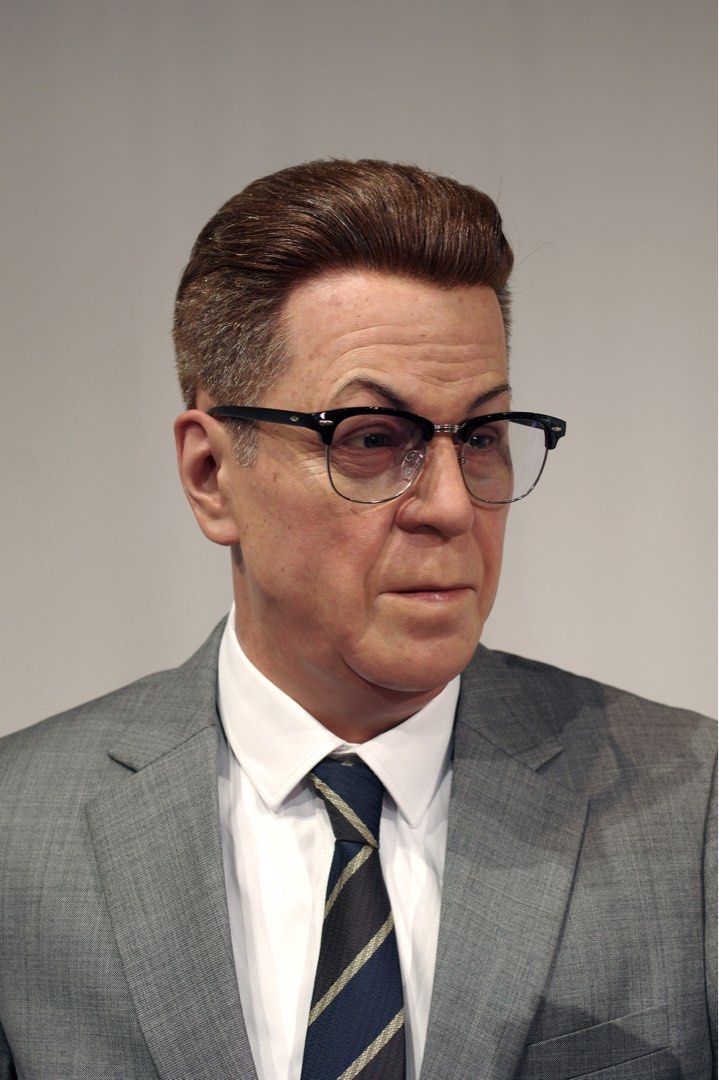
Percy Spencer · Raytheon
Meet the man
Percy
Spencer.
Massachusetts, USA07 / 17
06 · The AccidentOne sticky pocket
The spark
A candy bar
in his pocket.
- Standing near a magnetron
- Chocolate melted in his pocket
- Next test: popcorn popped
- Then: an egg exploded
Watch it melt08 / 17
07 · The First Microwave"Radarange" · 1947
Two years later
The first one
was huge.
It needed its own water cooling09 / 17
08 · Inside the BoxAnatomy
Four parts. One job.
01
Magnetron
Makes the waves.
02
Waveguide
Channels them in.
03
Turntable
Spins for evenness.
04
Faraday Cage
Keeps them inside.
Look at the door — see the holes?10 / 17
09 · The ScienceThe big idea
The mechanism is called
Dielectric
Heating.
- Doesn't heat the air
- Doesn't heat the plate
- Heats the water — by spinning it
H₂O · spinning → heat
One word to remember11 / 17
10 · The MechanismWater = tiny dipoles
+ red, − blue. Ask me why.12 / 17
11 · The SpeedHow fast they spin
The molecules flip
5,000,000,000
times per second.
Five billion rotations every second. That's where the heat comes from — pure friction at the molecular scale.
2.45 GHz = 2.45 billion cycles/sec × 2 directions13 / 17
12 · Myth Number OneFact-check
MYTH 01
"Microwaves make
food radioactive."
FACT
- Non-ionizing waves — no DNA damage
- Vanish the moment the door opens
- Like a lamp — off means off
Switch it off · light is gone
No glow, no leftover rays14 / 17
13 · Myth Number TwoFact-check
MYTH 02
"They destroy
all the nutrients."
FACT
- All heat destroys vitamins — not just microwaves
- Fast cooking · little water
- Often more nutrients than boiling
Boiling broccoli is the real villain15 / 17
14 · Myth Number ThreeFact-check
MYTH 03
"You can never
put metal inside."
NUANCE
- Sharp edges → sparks (forks, foil balls)
- Smooth metal → reflects safely
- The oven walls are metal!
- When in doubt: leave it out
Forks bad. Stainless mugs fine.16 / 17
15 · EndFin.
A wartime accident
That changed
dinner.
Thank you. Questions?
End of presentation17 / 17